

How to Use Present Participles Correctly at the Beginning of a Sentence
Sentences that begin with present participles (-ing ending verbs) are, as some of you know, one of my pet hates in writing. (Head hopping is the other one.) In my book The Elements of Active Prose: Writing Tips to Make Your Prose Shine, I recommend that authors use such a sentence construction no more than once every 10,000 words. One of the reasons why is because authors rarely use it correctly and often overuse it, at least in self-published books (unfortunately). Used badly and too often, it’s a mark of an unskilled writer and a lack of line editing—or a lack of education in the editor. So why am I talking about using it at all? Because when used occasionally and skilfully, it varies the sentence structure. Being too rigid in not using it at all limits your options. Sometimes it’s just right, but only if you don’t use it…

6 Benefits from Turning Your Book Into An Audiobook
Today I’m sharing a guest post from Alicia Gerrard, the director & founder of Audio Quants. Producing an audiobook is not cheap, but Alicia points out some of the reasons why the investment might be worth it. Of course, Audio Quants is just one of many audio book production companies, and like with everything you’re thinking of purchasing, you need to research your options before committing to anything. My advice if you do decide to make an audio book, is to have a good marketing plan in place before taking the plunge. You’ll not get back the money you spend on producing an audio book if you don’t market it. Now read what Alicia has to say: Audiobooks now rival print as the format of choice for literary consumers. For good reason too. Reasons, in fact! Here are Audio Quants’ six benefits to turning your book into an audiobook. 1.…
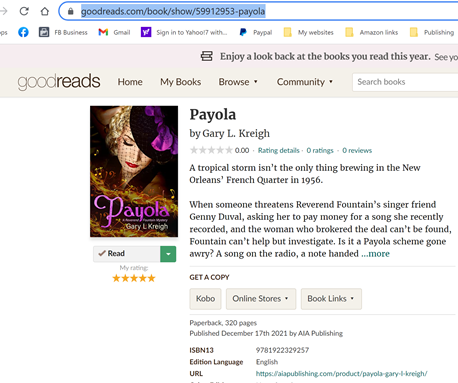
How to Put Your Book on Goodreads
Do you know how to put your book on Goodreads? Do you know what Goodreads is and why putting your book there might be a good idea? If your answer is no, read on. What is Goodreads? Goodreads is an online place where avid readers hang out so it’s a good place to have your book listed. As they say in their About Us section, ‘Goodreads is the world’s largest site for readers and book recommendations,’ and their mission is ‘to help people find and share books they love.’ The site is for readers, and if authors use it, they need to use it as a reader, not as an author trying to sell their book. Spam is ruthlessly suppressed, and in some groups any mention that you’ve written a book could be seen as spam. Nevertheless, the site does have a role to play in building an author platform.…

Watch for the Difference Between a Present Participle and a Gerund, also a Participle Adjective
The difference between a present participle and a gerund and also a participle adjective isn’t immediately obvious and may seem unimportant, but when looking at sophistication in writing, it’s helpful to know the difference. I’ve been making a bit of noise recently about the illadvised use of present participles to start sentences if we want our writing to look professional. See point one of my recent blog post and this video with 6 (+1) tips on writing better prose. However not every sentence starting with a word ending in ‘ing’ is problematic because not all words ending in ‘ing’ are present participles, some are gerunds and some, though they are still called participles, are participle adjectives not verbs. What’s the difference? Both a gerund and a present participle come from a verb, and both end in ‘ing’. However, each has a different function. A gerund acts like a noun while a present participle…

3 Little-Known Writing Mistakes: Avoid them and Improve Your Prose
Three writing mistakes that mark writing as that of an amateur seem to be breeding like flies in books written by unschooled or inadequately schooled authors. Clearly, these stylistic mistakes are little known, and it’s time that changed. I read mostly independently published books, and unfortunately, though there is a great number of superbly written books in indie publishing, I also see a lot of writing marred by these blunders. If not checked, these 3 writing mistakes, will rapidly, all by themselves, diminish the power, beauty and precision of the written English language. How such writing mistakes diminish the power of the written language It works like this. One author writes a number of books all containing the following mistakes, but they market their books well and use a cut-price promotion to get one of their books onto a book bestseller list. Then they call themselves a best-selling author, and…

5 Mistakes in Writing Backstory or Delivering Information in Fiction
Writing backstory into a novel or delivering information in an effective way can be challenging. Backstory refers to events that happened in the past, and information is anything the reader needs to know in order to understand the story. If you don’t study how best to include information and backstories into your novel, you’re likely to fall into one of the following mistakes. 1. Too much information Generally, the reader needs less information than you think they do. So go through the information you have about characters, events and the world in which the events take place and cut out anything that doesn’t directly impact on the present story. You’d be surprised at how much information will come out simply as part of writing scenes. Writing backstory in may not be necessary at all. If no event is linked to a piece of information, then you don’t need to include…

8 Steps to Answering the Question, Is My Book Any Good?
After writing 10 books myself and helping countless authors to do the same, I realise that at some point all authors ask Is my book any good? That’s the point at which most authors come to me for a manuscript appraisal, but there is another way you can get a good idea of whether your book is ‘any good’. When we evaluate ‘good’ in this context, we usually think in terms of how our book matches up to similar books. We’re wondering, Is our book as good as the others out there? Here’s a way to find out in 8 steps. Step 1: Take a break and read Take a break from working on your novel of at least 3 weeks (the longer the better) and read at least 3 quality books from the same genre. Choose competition winners and best sellers, books with thousands of reviews and no more…

Do We Put a Comma Before ‘Too’ or ‘Either’ at the End of a Sentence?
Do you put a comma before ‘too’ or ‘either’ at the end of a sentence? We used to, but language and how we use it changes over time, and the conventions we use to help us express meaning clearly eventually change in order to reflect this. Those of us involved in publishing need to update the way we do things when the style guides we follow change. Can’t we make our own punctuation convention style? Can we make our own style for our book, and just punctuate and capitalise and use grammar in any way we feel works for us? No, we can’t. Well, we can, but the book will be seen as poor quality, the author as an amateur hack, and no editor would put their name to such a book. The reason being that the conventions we follow are there to help readers understand what the author is…
Am I the Best Editor for You?
I wrote a post about how to find the best editor for your book, and that still stands as a good guide, so I won’t repeat it here. This post is just to show you the me I am now, because I look a bit different to when I last did a video introduction to myself and put it on the front page of this website. It’s shorter than the old video, not even 2 minutes. What hasn’t changed is my passion for my job. I love it, and you can be sure that if I agree to edit your book, I’ll be passionate about making it the best it can be. Anyway, here’s the little video. I did it so that potential clients could see and hear me – so they can see what a lovely person I am. (Smile!) What did you think of the video? Would you…

Writing Good Dialogue – Use Subtext
The most important thing for writing good dialogue is to make it sound natural, and reading it aloud is the way to find out if what you’ve written sounds natural or not. But really clever dialogue, dialogue that speaks far more than the words and that deepens the characters, uses subtext. This post follows on from 4 tips for writing dialogue. Subtext in dialogue People don’t actually say everything they think. In dialogue, less is often more, and is usually more realistic. If you want the reader to know what a character is feeling, you can write the character’s thoughts as thoughts, if you’re in their POV—they don’t have to express them to the other character. Of course, if you’re not in the POV of the character whose thoughts you want to communicate, then you don’t have the option of writing out their inner thoughts; but in either situation, you…